



Gifting Made Simple
Give the Gift of ChoiceClick below to purchase a Bramalea City Centre eGift Card that can be used at participating retailers at Bramalea City Centre.Purchase HereHome
Thermal Stability of Metastable Magnetic Skyrmions
Coles
Loading Inventory...
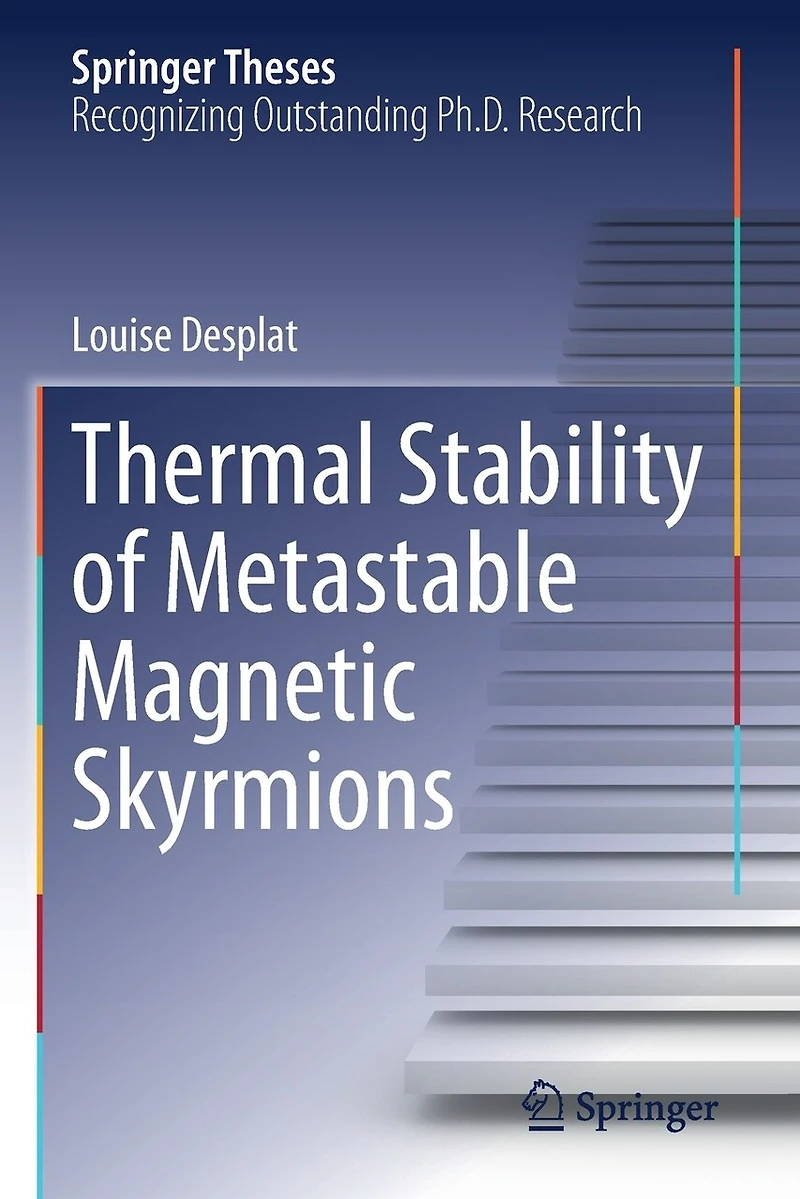
Thermal Stability of Metastable Magnetic Skyrmions in Brampton, ON
Current price: $248.50
Coles
Thermal Stability of Metastable Magnetic Skyrmions in Brampton, ON
Current price: $248.50
Loading Inventory...
Size: Paperback
*Product information and pricing may vary - to confirm current pricing, availability, shipping, and return information please contact Coles. In the event of a pricing discrepancy, the retailer's price will apply.
The energy cost associated with modern information technologies has been increasing exponentially over time, stimulating the search for alternative information storage and processing devices. Magnetic skyrmions are solitonic nanometer-scale quasiparticles whose unique topological properties can be thought of as that of a Mobius strip. Skyrmions are envisioned as information carriers in novel information processing and storage devices with low power consumption and high information density. As such, they could contribute to solving the energy challenge.
In order to be used in applications, isolated skyrmions must be thermally stable at the scale of years. In this work, their stability is studied through two main approaches: the Kramers' method in the form of Langer's theory, and the forward flux sampling method. Good agreement is found between the two methods. We find that small skyrmions possess low internal energy barriers, but are stabilized by a large activation entropy. This is a direct consequence of the existence of stable modes of deformation of the skyrmion. Additionally, frustrated exchange that arises at some transition metal interfaces leads to new collapse paths in the form of the partial nucleation of the corresponding antiparticle, as merons and antimerons.
The energy cost associated with modern information technologies has been increasing exponentially over time, stimulating the search for alternative information storage and processing devices. Magnetic skyrmions are solitonic nanometer-scale quasiparticles whose unique topological properties can be thought of as that of a Mobius strip. Skyrmions are envisioned as information carriers in novel information processing and storage devices with low power consumption and high information density. As such, they could contribute to solving the energy challenge.
In order to be used in applications, isolated skyrmions must be thermally stable at the scale of years. In this work, their stability is studied through two main approaches: the Kramers' method in the form of Langer's theory, and the forward flux sampling method. Good agreement is found between the two methods. We find that small skyrmions possess low internal energy barriers, but are stabilized by a large activation entropy. This is a direct consequence of the existence of stable modes of deformation of the skyrmion. Additionally, frustrated exchange that arises at some transition metal interfaces leads to new collapse paths in the form of the partial nucleation of the corresponding antiparticle, as merons and antimerons.
You May Also Like
















Find at Bramalea City Centre in Brampton, ON
Visit at Bramalea City Centre in Brampton, ON