



Gifting Made Simple
Give the Gift of ChoiceClick below to purchase a Bramalea City Centre eGift Card that can be used at participating retailers at Bramalea City Centre.Purchase HereHome
The Linear Model and Hypothesis: A General Unifying Theory
Coles
Loading Inventory...
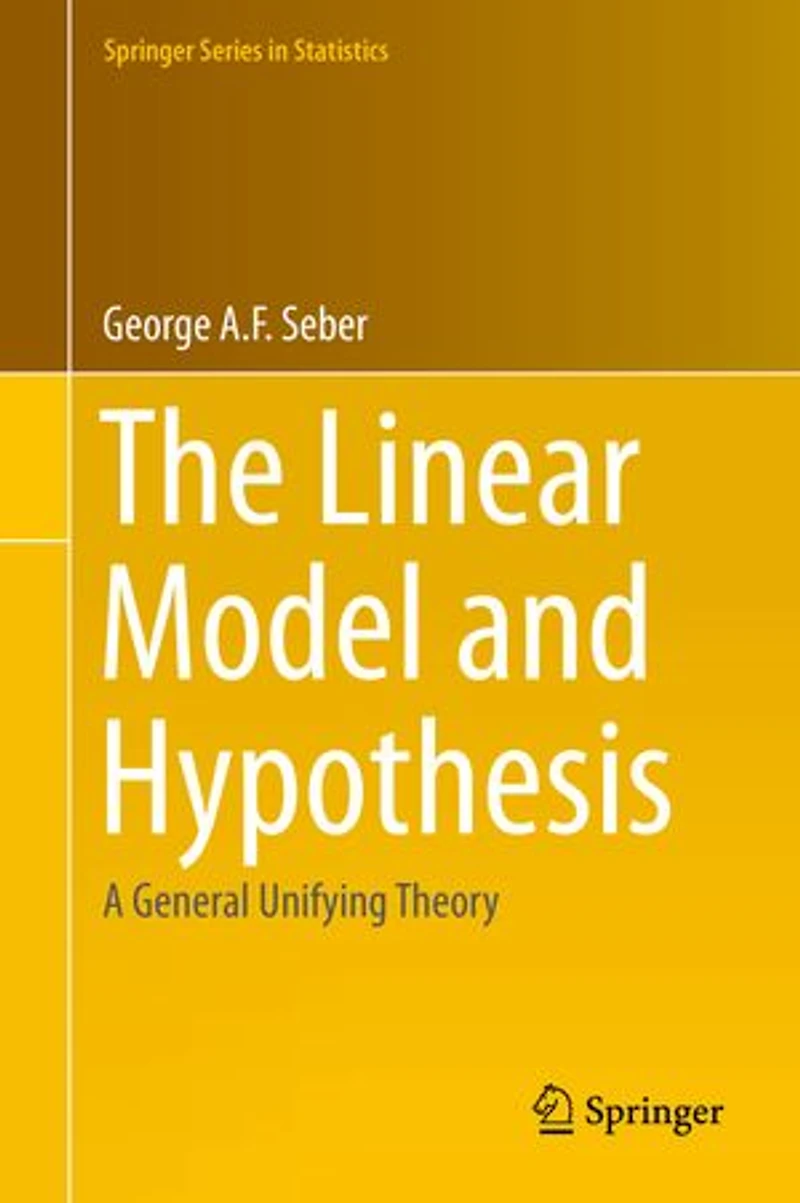
The Linear Model and Hypothesis: A General Unifying Theory in Brampton, ON
Current price: $70.99
Original price: $88.68
Coles
The Linear Model and Hypothesis: A General Unifying Theory in Brampton, ON
Current price: $70.99
Original price: $88.68
Loading Inventory...
Size: Kobo eBook
*Product information and pricing may vary - to confirm current pricing, availability, shipping, and return information please contact Coles. In the event of a pricing discrepancy, the retailer's price will apply.
This book provides a concise and integrated overview of hypothesis testing in four important subject areas, namely linear and nonlinear models, multivariate analysis, and large sample theory. The approach used is a geometrical one based on the concept of projections and their associated idempotent matrices, thus largely avoiding the need to involvematrix ranks. It is shown that all the hypotheses encountered are either linear or asymptotically linear, and that all the underlying models used are either exactly or asymptotically linear normal models. This equivalence can be used, for example, to extend the concept of orthogonality to other models in the analysis of variance, and to show that the asymptotic equivalence of the likelihood ratio, Wald, and Score (Lagrange Multiplier) hypothesis tests generally applies.
This book provides a concise and integrated overview of hypothesis testing in four important subject areas, namely linear and nonlinear models, multivariate analysis, and large sample theory. The approach used is a geometrical one based on the concept of projections and their associated idempotent matrices, thus largely avoiding the need to involvematrix ranks. It is shown that all the hypotheses encountered are either linear or asymptotically linear, and that all the underlying models used are either exactly or asymptotically linear normal models. This equivalence can be used, for example, to extend the concept of orthogonality to other models in the analysis of variance, and to show that the asymptotic equivalence of the likelihood ratio, Wald, and Score (Lagrange Multiplier) hypothesis tests generally applies.
You May Also Like











Find at Bramalea City Centre in Brampton, ON
Visit at Bramalea City Centre in Brampton, ON