



Gifting Made Simple
Give the Gift of ChoiceClick below to purchase a Bramalea City Centre eGift Card that can be used at participating retailers at Bramalea City Centre.Purchase HereHome
Descriptive Complexity, Canonisation, and Definable Graph Structure Theory
Coles
Loading Inventory...
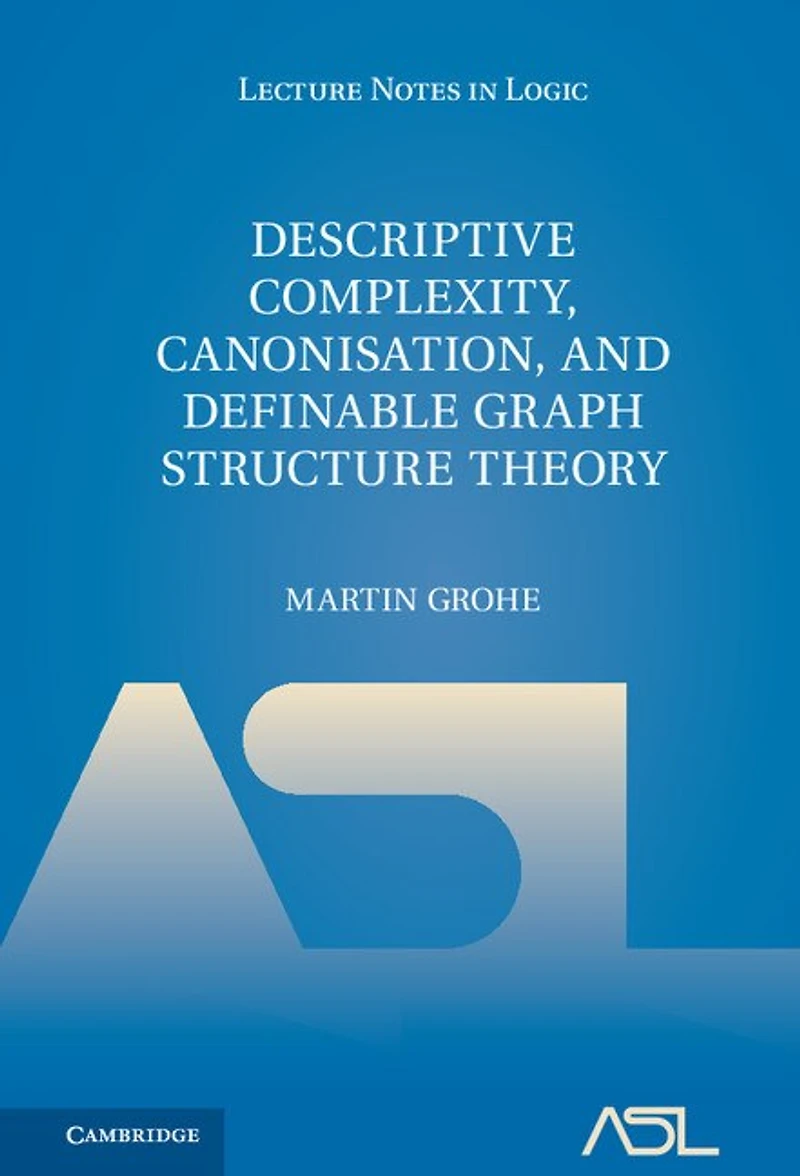
Descriptive Complexity, Canonisation, and Definable Graph Structure Theory in Brampton, ON
Current price: $261.95
Coles
Descriptive Complexity, Canonisation, and Definable Graph Structure Theory in Brampton, ON
Current price: $261.95
Loading Inventory...
Size: Hardcover
*Product information and pricing may vary - to confirm current pricing, availability, shipping, and return information please contact Coles. In the event of a pricing discrepancy, the retailer's price will apply.
Descriptive complexity theory establishes a connection between the computational complexity of algorithmic problems (the computational resources required to solve the problems) and their descriptive complexity (the language resources required to describe the problems). This groundbreaking book approaches descriptive complexity from the angle of modern structural graph theory, specifically graph minor theory. It develops a 'definable structure theory' concerned with the logical definability of graph theoretic concepts such as tree decompositions and embeddings. The first part starts with an introduction to the background, from logic, complexity, and graph theory, and develops the theory up to first applications in descriptive complexity theory and graph isomorphism testing. It may serve as the basis for a graduate-level course. The second part is more advanced and mainly devoted to the proof of a single, previously unpublished theorem: properties of graphs with excluded minors are decidable in polynomial time if, and only if, they are definable in fixed-point logic with counting.
Descriptive complexity theory establishes a connection between the computational complexity of algorithmic problems (the computational resources required to solve the problems) and their descriptive complexity (the language resources required to describe the problems). This groundbreaking book approaches descriptive complexity from the angle of modern structural graph theory, specifically graph minor theory. It develops a 'definable structure theory' concerned with the logical definability of graph theoretic concepts such as tree decompositions and embeddings. The first part starts with an introduction to the background, from logic, complexity, and graph theory, and develops the theory up to first applications in descriptive complexity theory and graph isomorphism testing. It may serve as the basis for a graduate-level course. The second part is more advanced and mainly devoted to the proof of a single, previously unpublished theorem: properties of graphs with excluded minors are decidable in polynomial time if, and only if, they are definable in fixed-point logic with counting.
You May Also Like









Find at Bramalea City Centre in Brampton, ON
Visit at Bramalea City Centre in Brampton, ON