



Gifting Made Simple
Give the Gift of ChoiceClick below to purchase a Bramalea City Centre eGift Card that can be used at participating retailers at Bramalea City Centre.Purchase HereHome
Asymptotic Modal Analysis of Structural and Acoustical Systems
Coles
Loading Inventory...
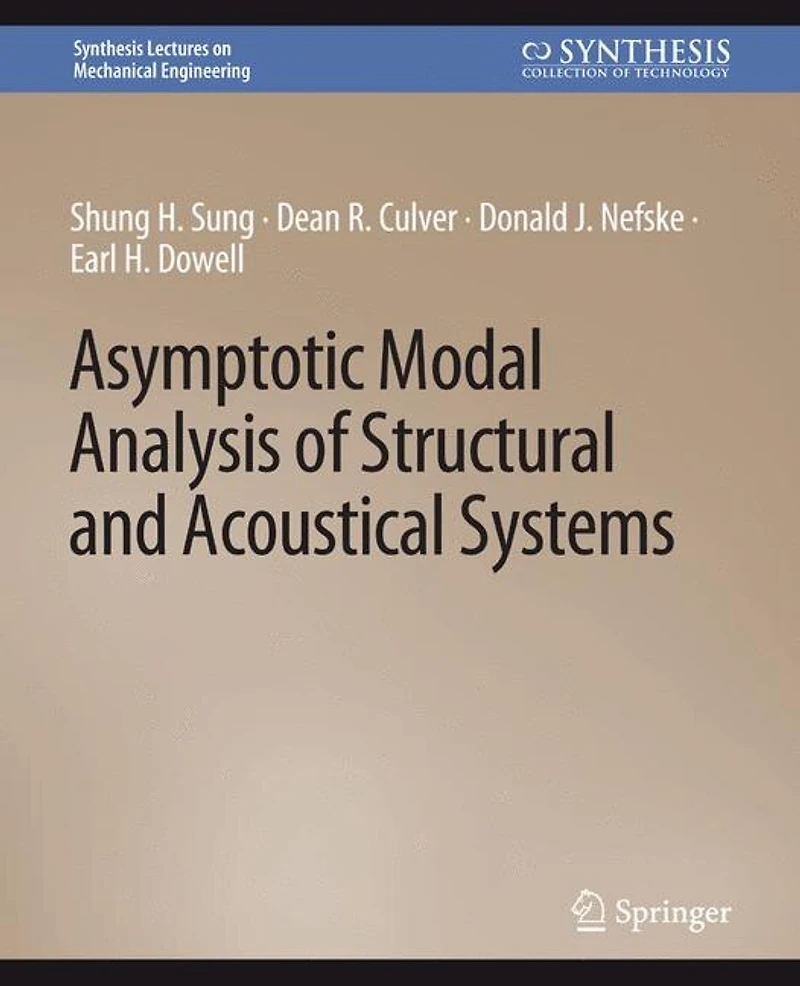
Asymptotic Modal Analysis of Structural and Acoustical Systems in Brampton, ON
Current price: $87.95
Coles
Asymptotic Modal Analysis of Structural and Acoustical Systems in Brampton, ON
Current price: $87.95
Loading Inventory...
Size: Paperback
*Product information and pricing may vary - to confirm current pricing, availability, shipping, and return information please contact Coles. In the event of a pricing discrepancy, the retailer's price will apply.
This book describes the Asymptotic Modal Analysis (AMA) method to predict the high-frequency vibroacoustic response of structural and acoustical systems. The AMA method is based on taking the asymptotic limit of Classical Modal Analysis (CMA) as the number of modes in the structural system or acoustical system becomes large in a certain frequency bandwidth. While CMA requires both the computation of individual modes and a modal summation, AMA evaluates the averaged modal response only at a center frequency of the bandwidth and does not sum the individual contributions from each mode to obtain a final result. It is similar to Statistical Energy Analysis (SEA) in this respect. However, while SEA is limited to obtaining spatial averages or mean values (as it is a statistical method), AMA is derived systematically from CMA and can provide spatial information as well as estimates of the accuracy of the solution for a particular number of modes. A principal goal is to present the state-of-the-art of AMA and suggest where further developments may be possible. A short review of the CMA method as applied to structural and acoustical systems subjected to random excitation is first presented. Then the development of AMA is presented for an individual structural system and an individual acoustic cavity system, as well as a combined structural-acoustic system. The extension of AMA for treating coupled or multi-component systems is then described, followed by its application to nonlinear systems. Finally, the AMA method is summarized and potential further developments are discussed.
This book describes the Asymptotic Modal Analysis (AMA) method to predict the high-frequency vibroacoustic response of structural and acoustical systems. The AMA method is based on taking the asymptotic limit of Classical Modal Analysis (CMA) as the number of modes in the structural system or acoustical system becomes large in a certain frequency bandwidth. While CMA requires both the computation of individual modes and a modal summation, AMA evaluates the averaged modal response only at a center frequency of the bandwidth and does not sum the individual contributions from each mode to obtain a final result. It is similar to Statistical Energy Analysis (SEA) in this respect. However, while SEA is limited to obtaining spatial averages or mean values (as it is a statistical method), AMA is derived systematically from CMA and can provide spatial information as well as estimates of the accuracy of the solution for a particular number of modes. A principal goal is to present the state-of-the-art of AMA and suggest where further developments may be possible. A short review of the CMA method as applied to structural and acoustical systems subjected to random excitation is first presented. Then the development of AMA is presented for an individual structural system and an individual acoustic cavity system, as well as a combined structural-acoustic system. The extension of AMA for treating coupled or multi-component systems is then described, followed by its application to nonlinear systems. Finally, the AMA method is summarized and potential further developments are discussed.
You May Also Like









Find at Bramalea City Centre in Brampton, ON
Visit at Bramalea City Centre in Brampton, ON